
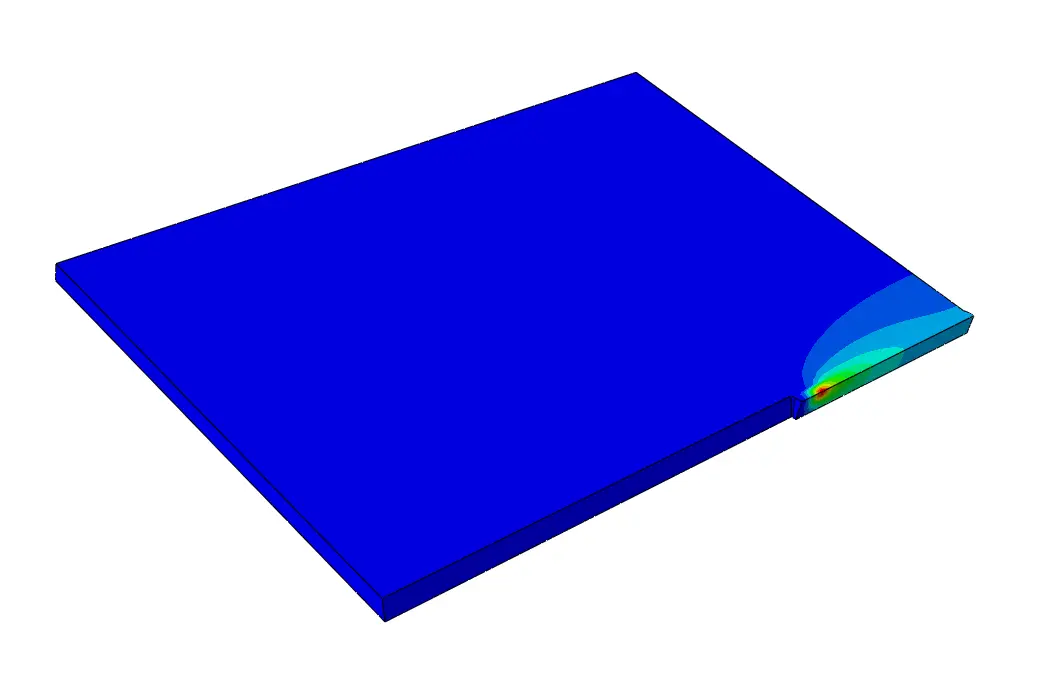
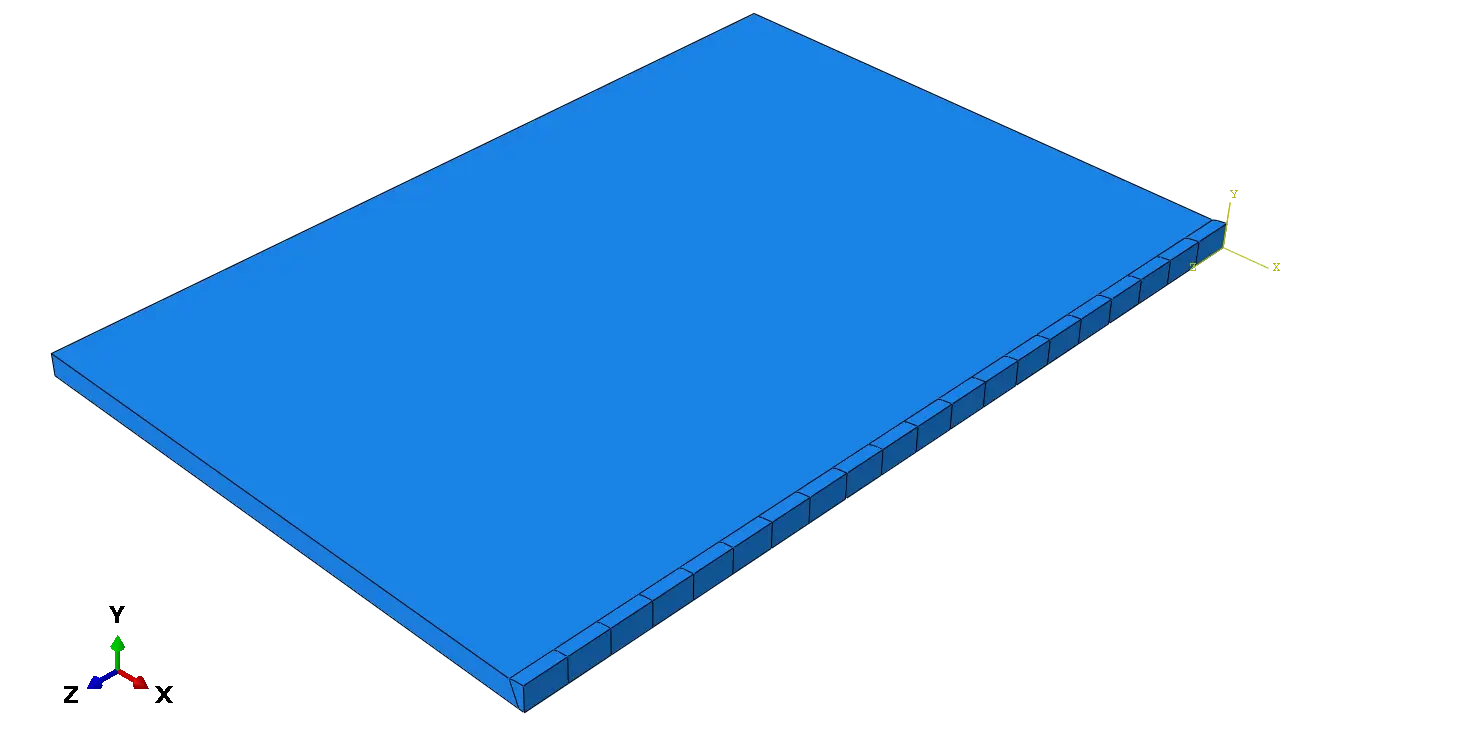

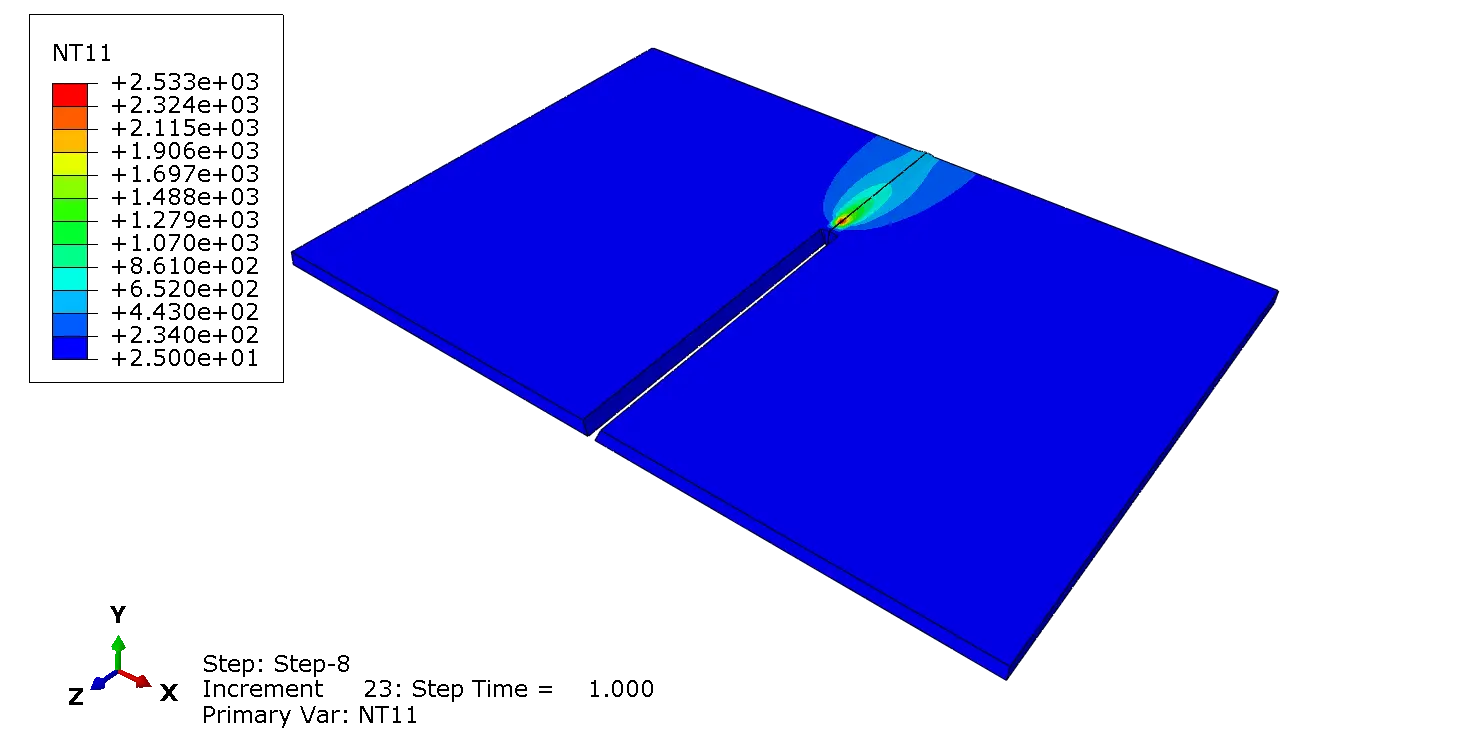

This complete simulation package delivers a production-ready Abaqus/Standard framework for transient thermal-mechanical analysis of ASTM-36 steel plate welding. Designed for a single pass symmetric weld, this model implements the Goldak double ellipsoid heat source (the most widely accepted volumetric flux distribution for arc welding processes). The package includes a fully parameterized Abaqus CAE model and a custom DFLUX user subroutine optimized for straight weld paths along the +Z axis.
What’s Included in the Welding Simulation Package
1. Abaqus CAE Model (.cae & .inp)
Complete 3D geometry of an ASTM-36 structural steel plate with 0.004 m thickness
Temperature-dependent thermal and mechanical material properties pre-assigned for ASTM-36
Symmetry boundary conditions applied to reduce computational cost while maintaining accuracy
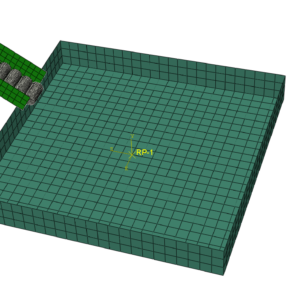
Refined mesh density in the weld fusion zone and heat-affected zone (HAZ)
Pre-configured analysis steps for thermal heat transfer and sequential coupled thermal-stress analysis
Pre-defined field output requests for temperature history, residual stress distribution, and plastic strain
2. DFLUX Subroutine (FORTRAN)
Implements the Goldak double ellipsoid volumetric heat flux model
Configured for a straight weld along the +Z direction
Heat source centered precisely on the top surface of the plate
Flux output in W/m³ for accurate volumetric energy deposition
Pre-tuned Goldak parameters (front ellipsoid, rear ellipsoid, width, and depth) for a standard single-pass weld
Requires BFNU flag activation in the input deck for proper body flux normalization—pre-configured in the provided files
Key Features & Advantages
Industry-Standard Heat Source Modeling: The Goldak double ellipsoid accurately captures the asymmetric heat distribution characteristic of moving arc welds, including the steep temperature gradient ahead of the arc and the longer thermal tail behind it.
Ready-to-Run: No geometry creation or material calibration required. Upload, compile the subroutine, and submit the job.
High Computational Efficiency: The symmetric half-model approach cuts simulation time by approximately 50% while delivering full-field results.
ASTM-36 Material Data Included: Pre-loaded with thermal conductivity, specific heat, density, elastic modulus, yield strength, and thermal expansion coefficients for ASTM-36 steel—ideal for structural welding applications.
Fully Parameterized: Easily modify welding speed, arc power, efficiency, or heat source dimensions directly within the FORTRAN subroutine.
Technical Specifications of Single pass welding model of plate
| Parameter | Specification |
|---|---|
| Plate Material | ASTM-36 Structural Steel |
| Plate Thickness | 0.004 m |
| Weld Type | Single Pass, Symmetric |
| Heat Source Model | Goldak Double Ellipsoid |
| Weld Direction | +Z Axis |
| Flux Units | W/m³ |
| Analysis Type | Thermal-Mechanical Coupled (Sequential) |
| Software | Abaqus/Standard (2022+) |
| Subroutine Language | FORTRAN |
| BFNU Requirement | Enabled in Input Deck |
Applications & Use Cases
This simulation package is ideal for:
Welding Engineers analyzing residual stresses and angular distortion in thin-section structural steel plates
Research Institutions validating experimental thermocouple data against numerical models
Graduate Students learning advanced welding simulation techniques in Abaqus
Manufacturing Engineers optimizing welding parameters to minimize distortion and prevent hot cracking
Quality Control Teams predicting post-weld mechanical properties and integrity
What You Will Achieve
By using this simulation package, you will be able to:
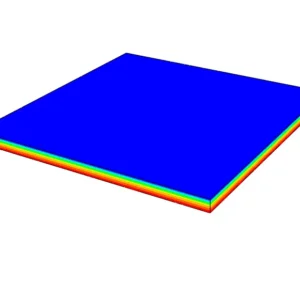
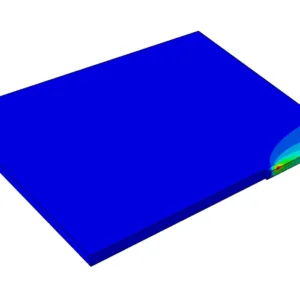
Predict transient temperature fields and thermal cycles during welding
Quantify residual stress distribution across the weld zone and base metal
Evaluate angular distortion and out-of-plane deformation
Estimate cooling rates to assess HAZ microstructure and hardness
Validate your welding procedures with confidence
System Requirements & Setup Notes
Abaqus/Standard version 2022 or newer
FORTRAN Compiler (Intel Visual Fortran or GNU Fortran) compatible with your Abaqus installation
BFNU flag must be active in the input deck—already set in the provided
.inpfileCoordinate system must align with subroutine definition: Weld along +Z, Top surface at Z=0
Delivery Contents
Job-Name.cae: Abaqus CAE model fileJob-Name.inp: Abaqus input deck with BFNU enableddflux.f: FORTRAN source code for Goldak double ellipsoid DFLUX subroutineREADME.txt: Step-by-step setup, compilation, and execution instructions
Symmetry in Single Pass Welding Simulation
The symmetric weld configuration in this package leverages the geometric and thermal symmetry about the weld centerline. By modeling only half of the plate and applying symmetry boundary conditions:
Computational cost is reduced by nearly 50%.
Solution time is cut significantly without sacrificing accuracy.
Post-processing is simplified because the full-field results can be mirrored.
This is especially beneficial for single pass welding where the heat source travels along a straight line and the plate geometry is uniform—conditions that are perfectly satisfied in this ASTM-36 model.
Thermal-Mechanical Coupling in Single Pass Welds
A complete simulation of single pass welding involves two coupled analyses:
Thermal Analysis (Transient Heat Transfer)
Solves the heat equation to compute temperature fields at each time increment.
Accounts for latent heat of fusion (if enabled).
Heat losses via convection and radiation are applied on exposed surfaces.
The moving heat source is applied via the DFLUX subroutine.
Mechanical Analysis (Static Stress/Displacement)
Reads the temperature history from the thermal analysis.
Computes thermal strains and resulting stresses at each integration point.
Accounts for temperature-dependent yield strength, elastic modulus, and hardening behavior.
Predicts permanent plastic strain and residual stress distribution.
Because single pass welding involves only one thermal cycle, the sequential coupling approach is computationally efficient while retaining high accuracy.
Why Choose This Package?
Unlike generic welding simulation templates, this package is specifically tailored for ASTM-36 steel and the Goldak heat source model- two of the most commonly used references in structural welding research and industry practice. The subroutine is thoroughly commented for transparency, and the CAE model is organized with named sets and surfaces for easy post-processing. Whether you are performing a one-off analysis or integrating this into a larger parametric study, this package provides a reliable, accurate, and efficient starting point.




Reviews
There are no reviews yet.