
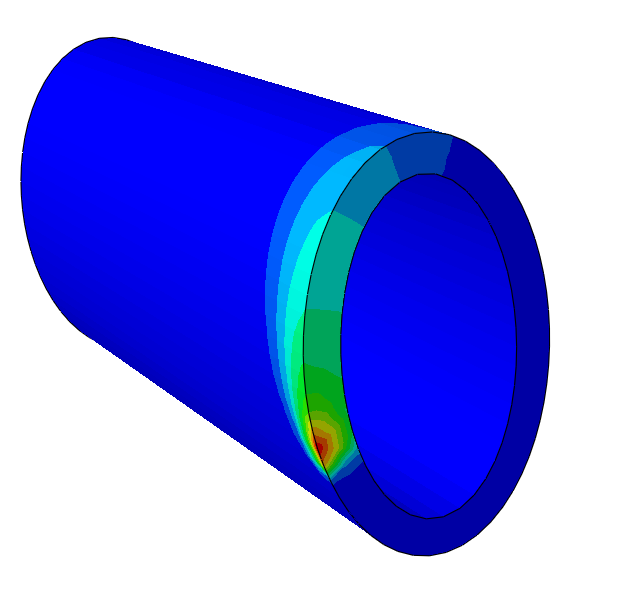
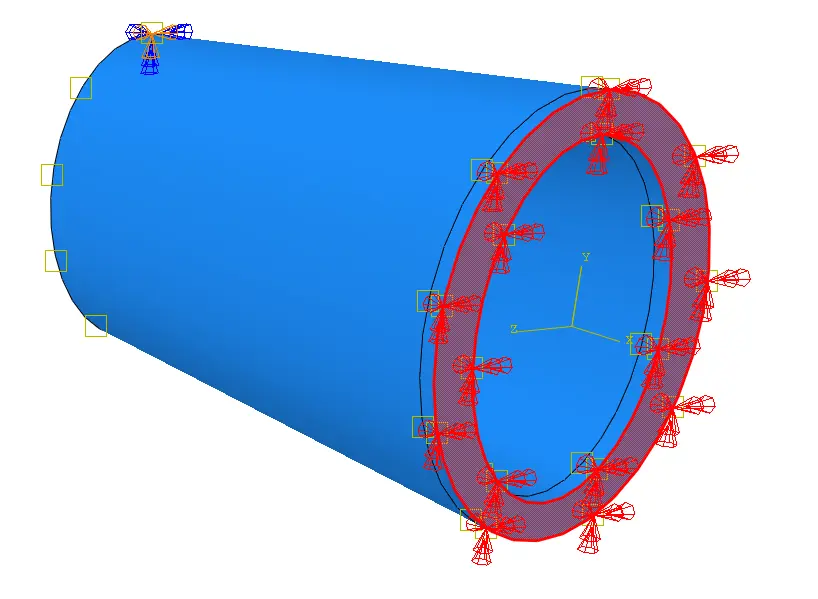
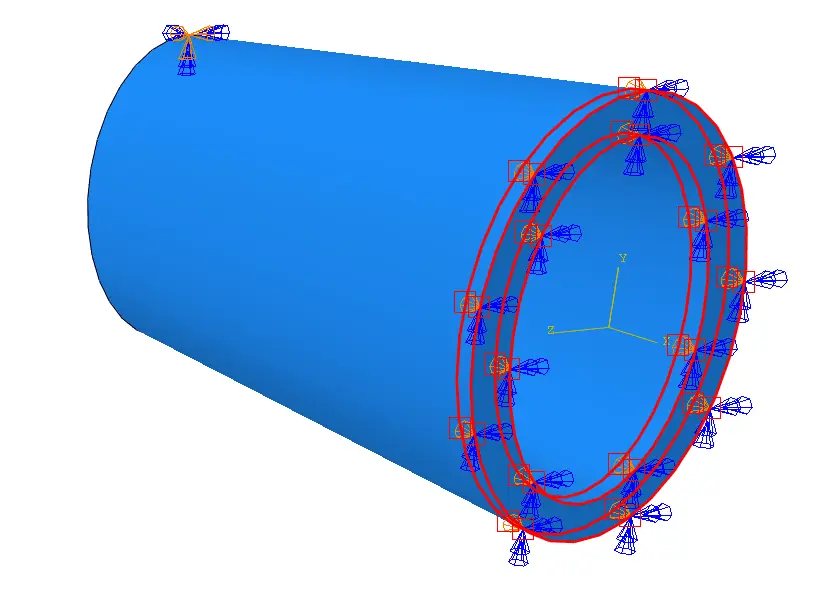

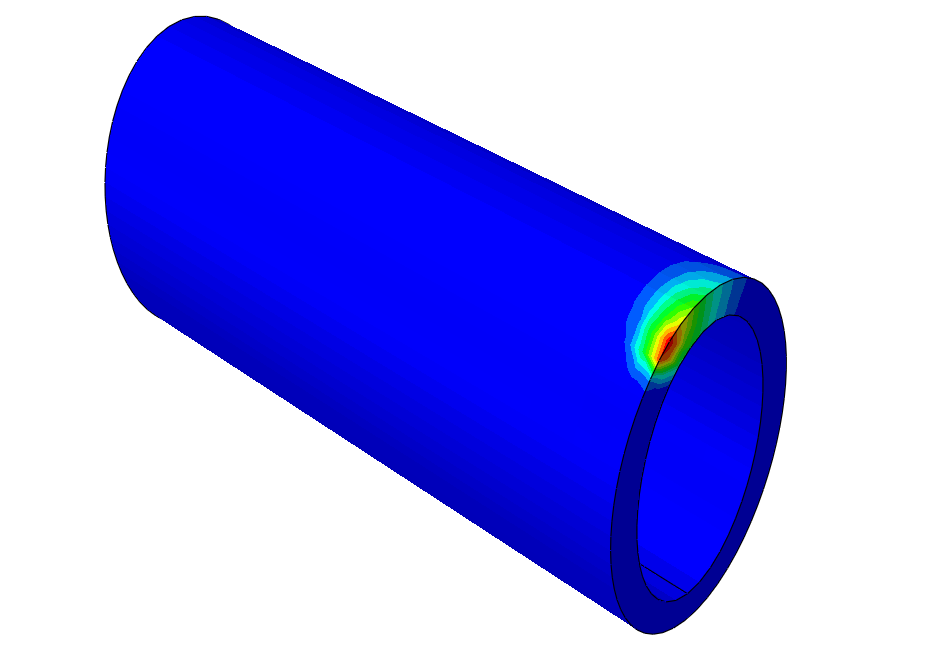
This Abaqus welding simulation demonstrates how to model a moving welding heat source along an elliptical path using a custom DFLUX Fortran subroutine.
📦 Download Package Includes:
- ✅ Fortran DFLUX subroutine for the moving welding heat source
- ✅ Abaqus INP file for running the analysis and reviewing the model definition
- ✅ Abaqus CAE File (.cae) ; ready-to-run model for the Welding on Elliptical Heat Source Path
Perfect for students, researchers, and simulation engineers who want to practice real FEM workflows in Abaqus.
This comprehensive simulation package provides a complete, ready-to-run solution for modeling welding along an elliptical path using a custom DFLUX Fortran subroutine. The model is suitable for engineers, researchers, and students working on welding simulation, transient thermal analysis, and finite element analysis (FEA) in Abaqus.
The welding heat source moves continuously along an elliptical trajectory defined by the major and minor semi-axes:
- Major diameter: 0.10 m
- Minor diameter: 0.06 m
The included DFLUX subroutine calculates the moving heat flux based on the position of the welding heat source along the elliptical path. This approach can be adapted for different welding trajectories, heat-source parameters, and process conditions.
Applications
This model can help you learn and implement:
- Moving heat-source modeling in Abaqus
- Welding thermal simulation
- DFLUX subroutine development
- Elliptical welding paths
- Transient heat transfer analysis
- User-defined heat flux in Abaqus
- Fortran subroutines for Abaqus
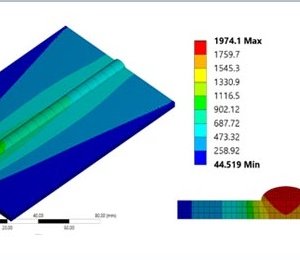
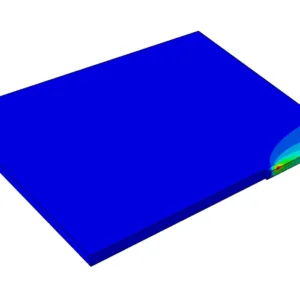
- Temperature distribution during welding
What’s Inside the Subroutine
- Simpson-rule arc-length integration (720 panels) for accurate elliptical perimeter computation
- Newton–Raphson inversion solving s(θ)=v⋅t at every increment, so the torch advances at genuinely uniform velocity
- Local moving coordinate frame — tangent and normal vectors projected onto the ellipse so the Goldak ellipsoid stays correctly oriented along the curved path
- Front and rear ellipsoid halves with independent parameters and fractional factors
- Multi-layer deposition logic using the Abaqus step index (
KSTEP), with a 0.002 m vertical offset per layer — no floating-point drift, no time-based truncation errors - Clean fixed-form Fortran, compiles without modification in Abaqus/Standard
📘 Learn How This CAE Model Was Built
This download includes the completed Abaqus CAE file. If you’d like to understand the complete modeling workflow, read our detailed tutorial that explains every step; from geometry creation and material definition to contact interactions, meshing, loading, solver settings, and contact pressure (CPRESS) visualization.
Who This Is For
Researchers and engineers running thermal and thermo-mechanical weld analysis: circumferential and closed-loop welds, ring and flange joints, elliptical repair passes, additive manufacturing deposition paths, residual stress and distortion prediction, HAZ characterization.
Key Advantages
✔ Constant travel speed ; physically correct heat input per unit length
✔ Fully parametric ; swap ae, be, power, efficiency, and velocity in seconds
✔ Multi-layer ready out of the box
✔ Extensible to circular, oval, or arbitrary parametric paths
✔ Heavily commented for learning, teaching, and adaptation
If you are developing a more advanced Abaqus welding simulation, this example provides a practical starting point for implementing custom moving heat sources and elliptical welding trajectories.
Need Expert Abaqus Simulation Support?
Whether you’re facing convergence problems, implementing advanced material models,
writing UMAT/VUMAT subroutines, or validating complex finite element analyses,
our Abaqus specialists can help you obtain accurate and reliable results.
✓ Abaqus Consulting
✓ UMAT Development
✓ Welding Simulation
✓ FEA Verification



Reviews
There are no reviews yet.