


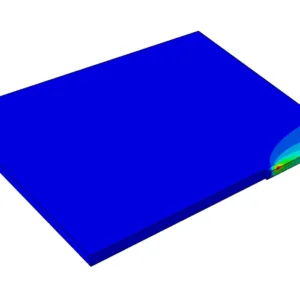
This Abaqus FEA project simulates the impact of a solid plate onto a rubber seal, followed by the damping and settling response of the rubber component.
The rubber seal undergoes significant nonlinear deformation during the impact. A Mooney-Rivlin hyperelastic material model is used to represent the nonlinear behavior of the rubber, while damping properties are included to capture energy dissipation and the subsequent damped response.
📦 Download Package Includes:
- ✅ Abaqus CAE File (.cae) – complete model of solid plate impact on a rubber seal
- ✅ Abaqus Input File (.inp) – ready-to-run input file for reproducing the simulation
- ✅ Abaqus Output Database (.odb) – simulation results for post-processing and result visualization
Perfect for students, researchers, and FEA engineers who want to study rubber hyperelasticity, Mooney-Rivlin material modeling, impact, contact, and damping in Abaqus.
Simulation Description
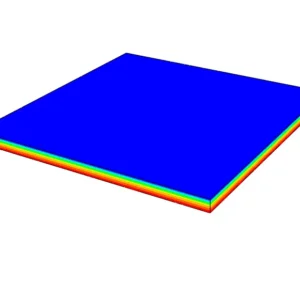
The model consists of a solid plate impacting the top surface of a rubber seal. During impact, the rubber experiences large deformation and develops a nonlinear restoring force. After the initial impact, the damping properties reduce the oscillations and allow the system to gradually settle.
The simulation demonstrates the complete response:
Plate Impact → Rubber Deformation → Energy Dissipation → Oscillation → Damped Response
Rubber Material Modeling
The rubber material is defined using:
Mechanical → Elasticity → Hyperelastic → Mooney-Rivlin
The Mooney-Rivlin strain energy potential is characterized by:
- C10
- C01
- D1
These parameters define the nonlinear elastic response of the rubber under large deformation.
Damping Properties
Damping is incorporated into the Abaqus material definition to represent energy dissipation during and after impact.
The project demonstrates damping parameters including:
- Alpha damping
- Beta damping
- Composite damping
- Structural damping
The damping causes the post-impact oscillations to gradually decrease until the plate approaches a stable position.
Analysis Features
The Abaqus model demonstrates:
- Solid plate impact
- Rubber seal deformation
- Hyperelastic material behavior
- Mooney-Rivlin formulation
- Large deformation
- Nonlinear contact
- Energy dissipation
- Damped oscillation
- Post-impact settling
- Stress and deformation analysis
Results
The simulation can be used to investigate the dynamic response of the rubber seal during and after impact, including:
- Plate displacement
- Rubber deformation
- Contact response
- von Mises stress
- Principal stresses
- Strain distribution
- Contact pressure
- Reaction forces
- Energy dissipation
- Post-impact oscillations
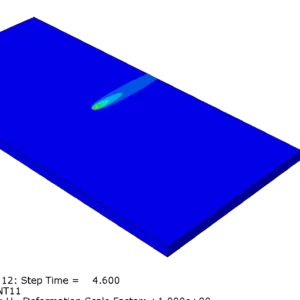
The resulting animation provides a clear visualization of how the rubber seal absorbs the impact energy and gradually damps the motion of the solid plate.
Engineering Applications
This type of simulation is relevant to many engineering systems involving rubber components and impact or transient loading, including:
- Rubber seals
- Elastomeric mounts
- Shock absorbers
- Vibration isolation systems
- Industrial sealing components
- Rubber pads
- Impact damping systems
- Mechanical cushioning systems
Project Information
Software: Abaqus/CAE
Analysis: Nonlinear dynamic FEA
Impact Object: Solid plate
Target: Rubber seal
Material Model: Mooney-Rivlin Hyperelasticity
Hyperelastic Parameters: C10, C01, D1
Additional Material Feature: Damping
Main Phenomenon: Impact and damped response
This project is a useful practical example for engineers and students learning hyperelastic rubber modeling, contact analysis, impact simulation, and damping in Abaqus.
Need Expert Abaqus Simulation Support?
Whether you’re facing convergence problems, implementing advanced material models,
writing UMAT/VUMAT subroutines, or validating complex finite element analyses,
our Abaqus specialists can help you obtain accurate and reliable results.
✓ Abaqus Consulting
✓ UMAT Development
✓ Nonlinear Analysis
✓ FEA Verification




Reviews
There are no reviews yet.