
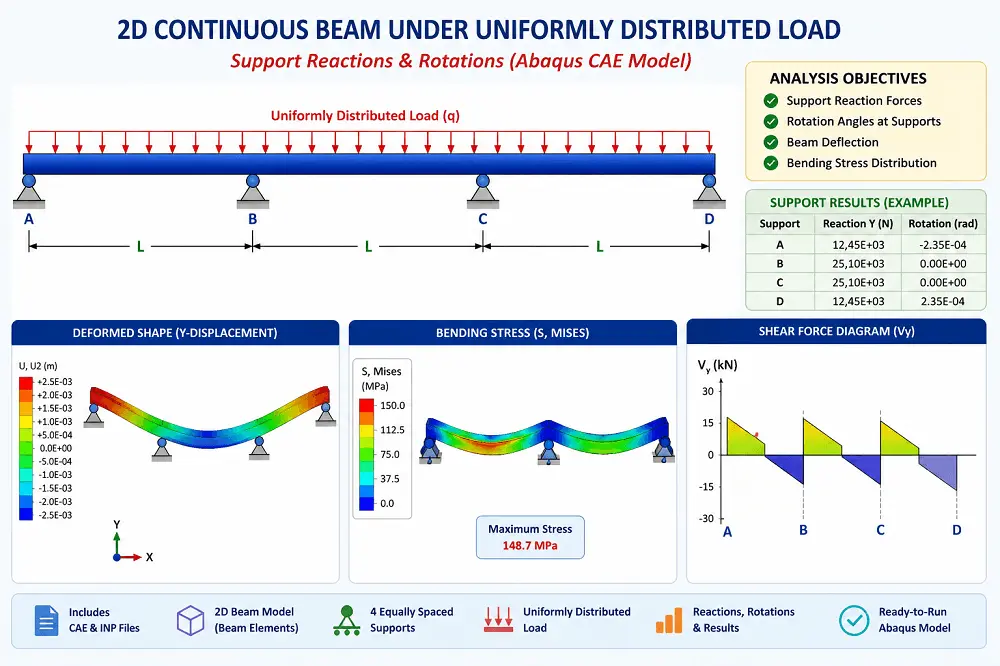
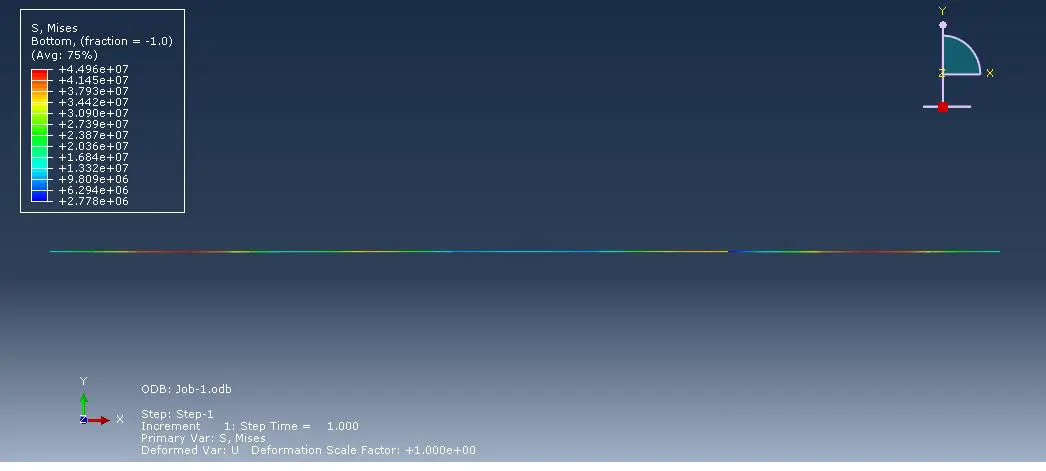
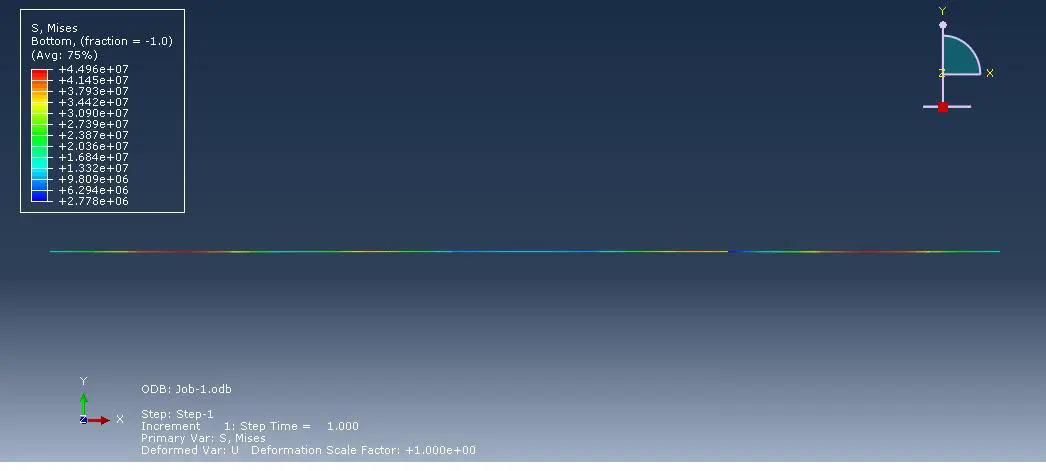
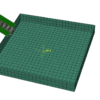
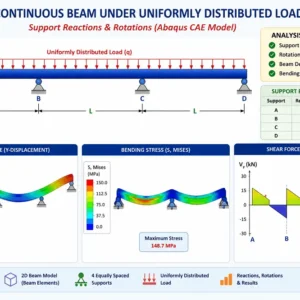
Model and analyze a two-dimensional continuous beam subjected to a uniformly distributed load (UDL) using Abaqus. In this example, the beam is supported at four equally spaced supports, and a constant distributed load is applied along the top surface. The objective is to determine the support reaction forces at each support and the rotation angles at the support locations through finite element analysis.
This Abaqus model is ideal for students, researchers, and structural engineers who want to learn beam analysis, validate analytical calculations, or understand how to model multi-support beam structures using beam elements in Abaqus.
Analysis Objectives
- Model a 2D continuous beam with four equally spaced supports.
- Apply a constant uniformly distributed load (UDL).
- Compute support reaction forces at all supports.
- Evaluate beam deflection and deformation.
- Determine rotation angles at each support.
- Visualize bending behavior and internal force distribution.
Download Package Includes
- ✅ Abaqus CAE file (.cae)
- ✅ Abaqus Input file (.inp)
- ✅ Ready-to-run simulation model
- ✅ Predefined material properties, boundary conditions, and loading
- ✅ Post-processing results for displacement, support reactions, and rotations
Learning Outcomes
This example helps you learn how to:
- Create and analyze 2D beam models in Abaqus.
- Define beam section properties and material data.
- Apply uniformly distributed loads.
- Assign multiple support boundary conditions.
- Extract support reaction forces and rotational degrees of freedom.
- Interpret displacement and structural response of continuous beams.
This example is suitable for structural analysis courses, finite element method (FEM) training, and civil and mechanical engineering education.



Reviews
There are no reviews yet.