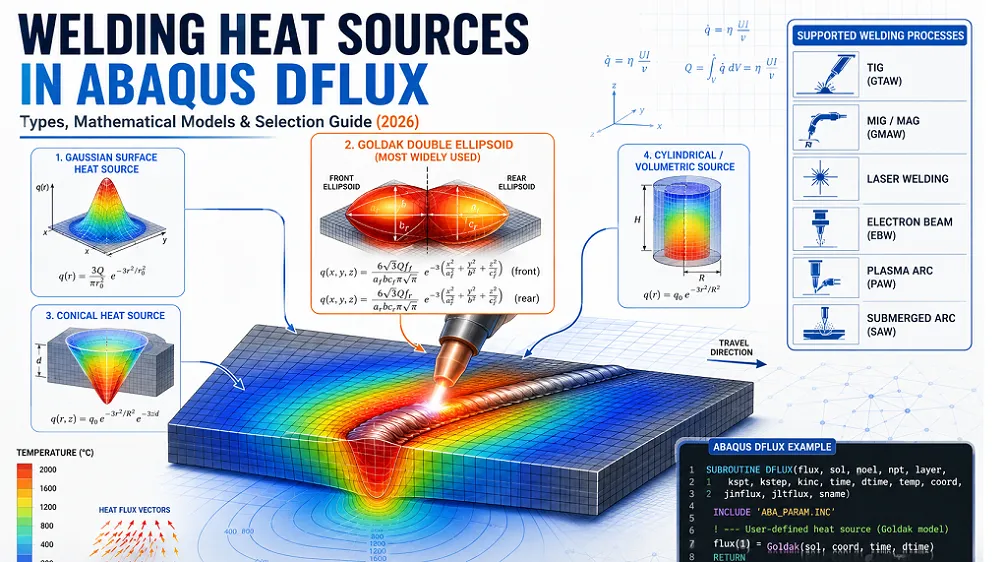
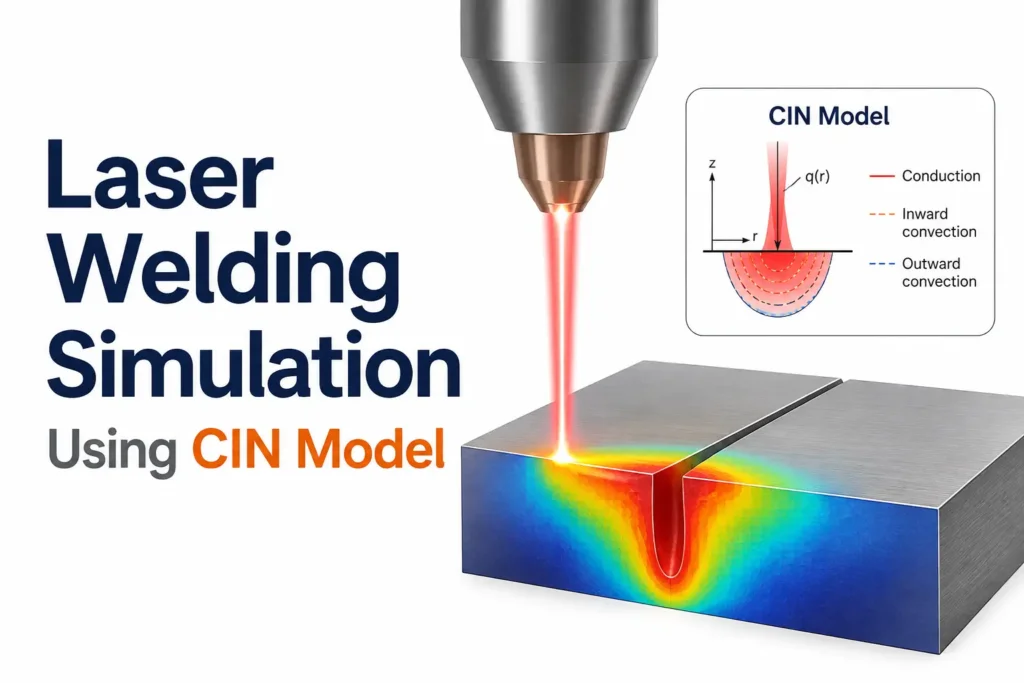
The CIN (cylindrical-involution-normal) model is a volumetric heat-source model designed for deep-penetration welding processes, particularly laser and electron-beam welding of thick sections. It combines a Gaussian radial distribution with an exponentially varying depth distribution and a finite penetration depth.
The name CIN describes the structure of the model. The radial direction follows a normal (Gaussian) distribution, while the depth direction follows an exponential distribution inside a finite cylindrical region.
What Is the CIN Heat Source Model?
Unlike a surface Gaussian heat source, the CIN model applies heat throughout a three-dimensional volume. This makes it useful for representing narrow and deep penetration in beam welding.
The model can be understood through three main components:
- Cylindrical: the heat source forms a narrow column around the beam axis.
- Involution: the heat intensity changes exponentially with depth.
- Normal: the radial distribution follows a Gaussian function.
The combination of these features produces a narrow, deep volumetric heat source that is suitable for deep-penetration welding.
CIN Heat Source Formulation
For a coordinate system where z increases into the workpiece, the CIN volumetric heat source can be written as:
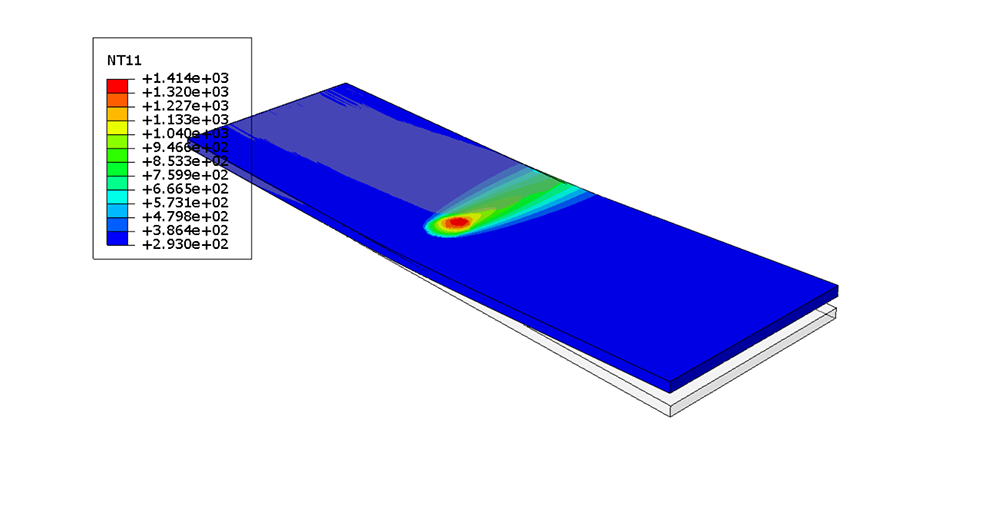
The radial distance from the beam axis is:
The model coefficients are:
k = 3 / r02
Here, Q represents the volumetric heat-generation rate. The exact units depend on the unit system used in the Abaqus model.
Coordinate Convention and Sign of the Depth Term
The sign of the depth exponent depends on the coordinate convention used by the heat-source formulation.
If z = 0 is the top surface and z increases into the workpiece, the heat intensity should decrease as the depth increases. Therefore, the depth-dependent term is:
The corresponding normalization term is:
Understanding the CIN Model Term by Term
Radial Gaussian Distribution
The radial component of the CIN model is:
This term controls how the laser energy spreads away from the beam centerline.
The radial distance is:
The radial focus coefficient is:
At r = r0, the Gaussian term becomes:
Therefore, the intensity at the specified beam radius is approximately 5% of the centerline value.
Depth Distribution
The depth-dependent component is:
where:
The parameter s represents the characteristic penetration depth.
At z = s:
Thus, the exponential depth component has decreased to approximately 5% of its surface value at z = s.
Heaviside Cutoff — The Cylindrical Boundary
The Heaviside step function restricts the heat source to a finite depth:
0, z ≥ s
This term acts as a binary spatial mask.
| Position | 1 − u(z − s) | Heat Source |
|---|---|---|
| z < s | 1 | Active |
| z ≥ s | 0 | Inactive |
Therefore, the Heaviside function effectively cuts off the volumetric heat source at the specified penetration depth.
Why Is the Heaviside Function Used?
Without the Heaviside term, the exponential depth distribution would continue beyond the intended penetration region.
The exponential term controls how the heat decreases, while the Heaviside function controls where the heat source stops.
For a cylindrical region extending from z = 0 to z = s, the active region is:
Laser Power and Absorption Efficiency
The parameter q represents the absorbed laser power. It can be expressed as:
where:
- η is the laser absorption efficiency.
- Plaser is the laser power.
- q is the absorbed power delivered to the workpiece.
Normalization of the CIN Heat Source
The prefactor of the CIN equation normalizes the volumetric heat source so that integration over the active volume gives the specified absorbed power.
This normalization is important because changing r0 or s changes the spatial distribution of the heat source. The total absorbed power should still remain equal to q.
Physical Meaning of CIN Parameters
| Symbol | Meaning | Role in the Model |
|---|---|---|
| q | Absorbed laser power | ηPlaser |
| r0 | Beam radius | Controls radial spreading |
| s | Penetration depth | Controls depth distribution and cutoff |
| k | Radial focus coefficient | 3/r02 |
| Kz | Depth coefficient | 3/s |
| u(z − s) | Heaviside function | Truncates the heat source at z = s |
CIN Model vs. Other Welding Heat Sources
The CIN model is specialized for narrow, deep-penetration beam welding. It should not be considered a universal replacement for other welding heat-source models.
| Heat Source | Distribution | Typical Application | Penetration |
|---|---|---|---|
| Surface Gaussian | Surface Gaussian | Laser heating and welding | Primarily surface-based |
| Goldak Double Ellipsoid | Asymmetric volumetric | Arc welding | Wide and relatively deep |
| Gaussian Ellipsoid | 3D Gaussian | Laser and arc welding | Smooth volumetric penetration |
| CIN | Gaussian radial + exponential depth | Laser and electron-beam welding | Narrow and deep |
CIN vs. Surface Gaussian
A surface Gaussian heat source applies heat primarily at the top surface. CIN distributes heat throughout a finite volume.
Therefore, CIN is more suitable when the welding process produces a narrow and deep fusion zone.
CIN vs. Goldak Double-Ellipsoid
The Goldak double-ellipsoid model divides the heat source into front and rear regions. This allows it to represent front/rear asymmetry in the weld pool.
CIN is axisymmetric around the beam axis and does not contain the front/rear parameters used by the Goldak model.
Therefore, CIN is better viewed as a specialized heat-source model for deep-penetration beam welding rather than a direct replacement for Goldak.
CIN vs. Gaussian Ellipsoidal Heat Source
A Gaussian ellipsoidal heat source provides a smooth three-dimensional distribution. CIN instead combines a Gaussian radial distribution with an exponential depth distribution and a finite-depth cutoff.
This produces a more column-like heat-source geometry that is useful for narrow and deep penetration.
Implementing the CIN Model in Abaqus
In Abaqus, the CIN model can be implemented as a moving volumetric heat source. The position of the laser beam changes with time, while the heat-source distribution is evaluated relative to the current beam position.
For a laser moving in the x-direction with velocity v, the beam center can be written as:
The radial distance from the moving beam axis then becomes:
This moving coordinate is substituted into the CIN equation at each integration point during the transient analysis.
Advantages of the CIN Heat Source Model
- Represents a volumetric rather than purely surface heat source.
- Produces strong penetration in the depth direction.
- Uses a Gaussian distribution around the beam axis.
- Provides an explicit penetration-depth parameter.
- Can be implemented as a moving heat source in Abaqus.
- Is suitable for narrow and deep laser welding applications.
- Can be normalized to a specified absorbed laser power.
Limitations of the CIN Model
CIN should not be considered a universal heat-source model for every welding process.
- It is primarily suited to deep-penetration beam welding.
- It assumes an axisymmetric radial distribution around the beam axis.
- It does not provide the front/rear asymmetry available in the Goldak model.
- Its parameters require calibration against experimental weld-pool data.
- The coordinate convention must be handled carefully when implementing the depth exponent.
- The model does not explicitly resolve keyhole physics such as vaporization, recoil pressure, free-surface deformation, or melt-pool convection.
Calibration of CIN Parameters
The parameters q, r0, and s strongly influence the predicted temperature distribution and fusion-zone geometry.
Laser Power and Absorption Efficiency
The absorbed power is commonly estimated using:
The absorption efficiency η should be calibrated using experimental data whenever possible.
Beam Radius
The parameter r0 controls the radial width of the heat source. Increasing r0 produces a wider heat distribution, while decreasing r0 concentrates the energy closer to the beam axis.
Penetration Depth
The parameter s controls the characteristic depth of the heat source and the location of the Heaviside cutoff.
In practical welding simulations , s should be calibrated against the experimentally measured penetration or fusion-zone depth.
What Does the CIN Model Represent Physically?
The CIN model should be interpreted as a mathematical representation of the spatial distribution of absorbed laser energy.
It can reproduce a narrow and deep thermal field that resembles the characteristic fusion-zone geometry of deep-penetration laser welding.
However, it does not directly solve the fluid mechanics and free-surface physics of a real keyhole.
Summary
The CIN heat-source model provides a practical volumetric formulation for simulating deep-penetration laser and electron-beam welding.
Its radial distribution follows a Gaussian profile, while its depth distribution follows an exponential law and is truncated at a finite penetration depth using a Heaviside function.
The most important parameters are the absorbed power q, beam radius r0, penetration depth s, radial coefficient k, and depth coefficient Kz.
Compared with a surface Gaussian heat source, CIN provides a volumetric penetration profile. Compared with the Goldak double-ellipsoid model, CIN is more specialized for narrow, deep beam welding and does not include front/rear asymmetry.
Need Expert Abaqus Laser Welding Simulation Support?
Whether you’re facing convergence problems, implementing advanced material models, writing Dflux subroutines, or validating complex welding analyses, our Abaqus specialists can help you obtain accurate and reliable results for your welding models.