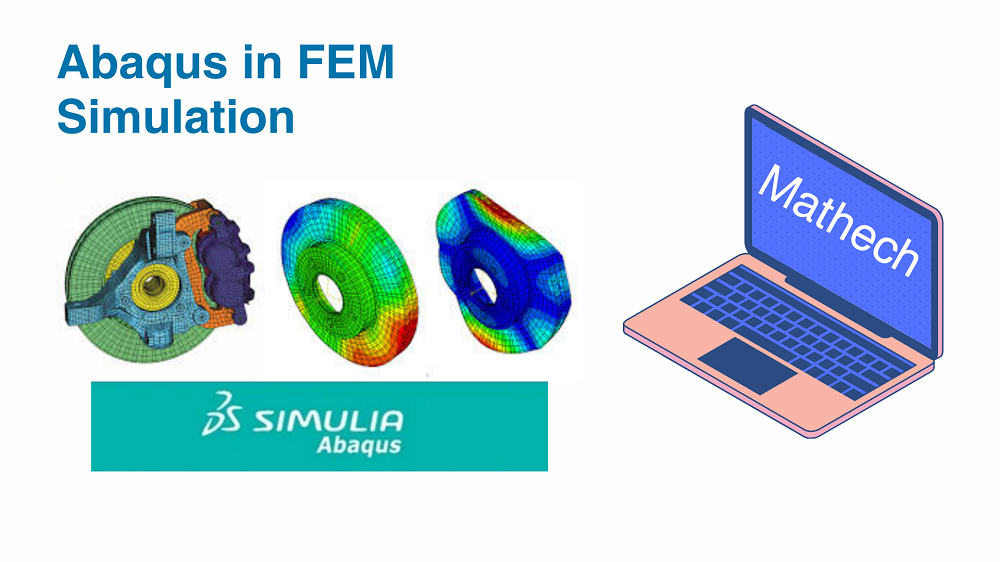
Abaqus is one of the best available software solutions today, it renowned for its peak performance, advanced material modeling, and wide variety of applications.
Whether you are simulating complex mechanical assemblies, predicting structural behavior, or conducting multiphysics analyses, Abaqus offers a comprehensive environment for engineers and researchers.
At Mathech.com, where we specialize in FEM and CFD consulting, we leverage powerful tools like Abaqus to deliver high-quality, reliable simulations to our clients. In this article, we’ll dive into why Abaqus is a top choice for FEM simulation, explore its key advantages, and discuss its real-world applications.
What is Abaqus?
Abaqus is a suite of software applications for finite element analysis and computer-aided engineering. Originally developed in the late 1970s, it has grown into one of the most trusted simulation platforms in industries such as automotive, aerospace, manufacturing, and energy.

The software consists of several core products:
- Abaqus/Standard (for static, low-speed dynamic events)
- Abaqus/Explicit (for highly nonlinear and transient dynamic events)
- Abaqus/CAE (for pre-processing and post-processing)

Each component serves a specific purpose, making Abaqus suitable for a wide range of simulations — from simple linear problems to complex non-linear and time-dependent analyses.
Advantages of Using Abaqus for FEM Simulation
1. Comprehensive Material Modeling
Abaqus offers an extensive library of material models, including metals, polymers, composites, soils, and biological tissues. It supports highly nonlinear behaviors like plasticity, hyperelasticity, viscoelasticity, and creep, providing accurate predictions for real-world materials under different conditions.

For example, at Mathech.com, our FEM simulation services often involve complex material behaviors in automotive and aerospace components, where simple linear models are insufficient.
2. Robust Nonlinear Analysis Capabilities
Many engineering problems involve large deformations, complex contacts, and material nonlinearities. Abaqus excels at solving these challenges efficiently with powerful solvers, automatic stabilization, and advanced contact algorithms.

3. Multiphysics Simulation
Abaqus can handle coupled analyses like thermo-mechanical, electro-mechanical, and fluid-structure interactions (FSI). This is essential for industries that demand simulations where multiple physical effects interact simultaneously.
Example: Predicting thermal stresses in electronic devices where heat generation affects mechanical behavior.

4. Advanced Contact and Interaction Modeling
One of Abaqus’ standout features is its sophisticated contact modeling capabilities, essential for assemblies with multiple interacting components. Whether it’s metal forming, crash simulations, or gear meshing, Abaqus ensures accurate and stable contact solutions.

5. Scalability and Performance
Thanks to its high-performance parallel processing capabilities, Abaqus can solve large-scale models involving millions of degrees of freedom. This scalability makes it ideal for handling both small R&D models and full-scale industrial assemblies.
6. Integration with Other Software
Abaqus seamlessly integrates with tools like:
- CATIA for CAD modeling
- Isight for process automation
- Ansys Fluent for advanced CFD-FSI coupling (using co-simulation)
This ecosystem provides engineers with a complete simulation platform without the need for cumbersome data transfers.
Applications of Abaqus in Industry
Aerospace and Automotive
Abaqus is widely used in the aerospace and automotive industries for simulating complex structural, thermal, and multiphysics problems. Its advanced nonlinear FEA capabilities help optimize designs, improve safety, and reduce costs. Below are key applications in each sector:
- Crashworthiness simulations
- Fatigue and durability analysis
- Noise, vibration, and harshness (NVH) studies
Static/dynamic load testing (e.g., bending, torsion, aerodynamic forces).
Fatigue & crack growth in aluminum/composite structures.
Impact & shock absorption simulations.
Delamination, fiber breakage, and matrix cracking.
- Crashworthiness & bird-strike simulations
Thermal-stress coupling due to high-speed rotation.
Structural integrity under extreme failure conditions.
Vibration analysis during launch (random & harmonic loads).
Occupant safety analysis using explicit dynamics.
Thermal cycling effects on bolts, gears, and housings.

Example: At Mathech.com, we assist clients with FEM consulting for automotive crash analysis, helping optimize designs to meet safety regulations.
Civil Engineering
Abaqus is widely used in civil engineering for simulating complex structural and geotechnical problems. Here are some key applications:
- Earthquake responses of structures
- Foundation settlement
- Soil-structure interaction
Analysis of static/dynamic loads (e.g., vehicle loads, wind, seismic effects).
Bridge Fatigue and fracture assessment.
Cable-stayed and suspension bridge simulations.
Reinforced concrete & steel frame analysis.
Progressive collapse assessment.
Seismic performance evaluation (nonlinear behavior).
Pile foundations under vertical/lateral loads.
Retaining walls and deep excavations.
Stability analysis of tunnels.
Time-history analysis under earthquake loads.
Abaqus is particularly useful for nonlinear analysis, large deformation problems, and complex material modeling, making it a preferred tool for advanced civil engineering simulations.

Biomedical Engineering
Abaqus enables simulations like:
- Orthopedic implant performance
- Cardiovascular stent deployment
- Soft tissue deformation
Its accurate biological material models are crucial for developing reliable medical devices.

Energy Sector
Abaqus is extensively used in the energy sector for simulating complex mechanical, thermal, and multiphysics problems. Its advanced finite element analysis (FEA) capabilities help optimize designs, ensure structural integrity, and improve safety in various energy-related applications.
- Pipeline integrity assessment
- Wind turbine load analysis
- Offshore structure stability
Stress analysis under internal/external pressure, thermal loads, and bending.
Buckling and collapse analysis (e.g., upheaval buckling).
- Hydrodynamic loading and structural response
- Stress analysis under high-pressure/high-temperature (HPHT) conditions
Wellbore stability analysis in shale formations.
ASME code compliance checks.
Composite material failure analysis under aerodynamic loads.
Fatigue life prediction (due to cyclic wind loads).

Frequently Asked Questions (FAQ)
What makes Abaqus different from other FEM software like Ansys?
Abaqus is particularly renowned for its advanced nonlinear analysis and material modeling capabilities. It excels in simulating complex contact problems and highly nonlinear behaviors. For more information, check out our article on choosing the right FEM software.
Can Abaqus simulate fluid flow like CFD software?
While Abaqus supports fluid-structure interaction (FSI), it is not a substitute for dedicated CFD software like Ansys Fluent. However, it can be coupled with CFD tools for co-simulation. Learn more about our consultation services.
Is Abaqus suitable for small businesses and startups?
Yes! Abaqus offers flexible licensing options ideal for startups and small businesses. It can significantly reduce development costs during the prototyping phase. Contact us for tailored solutions at Mathech.com.
 Read more about SIMULIA Computational Fluid Dynamics Simulation Key Benefits
Outbound Resources
For readers wanting a deeper dive into FEM simulation, here are some helpful external resources:
- Dassault Systèmes Official Abaqus Page – for official product information.
- NAFEMS – a professional organization dedicated to the engineering simulation community.
- Engineering.com FEM Section – great articles and case studies on FEM applications.
Conclusion
Abaqus stands as one of the most advanced and versatile finite element analysis (FEA) tools in the industry. With its robust nonlinear capabilities, extensive material modeling options, and seamless multiphysics integration, it empowers engineers to achieve highly accurate and efficient simulations.
At Mathech.com, we leverage the full potential of Abaqus to provide cutting-edge simulation consulting services, enabling businesses to optimize designs, reduce risks, and drive innovation with confidence.
If you’re interested in using FEM simulations to accelerate your projects, don’t hesitate to contact us today — we’ll help you turn complex engineering challenges into actionable solutions.